


There’s a specific kind of silence every new parent learns to fear. You’ve finally, finally gotten the baby down. You back out of the room like you’re defusing something explosive, holding your breath on the creaky floorboard. And then — thirty, maybe forty minutes later — that unmistakable squawk starts up again.
If you’ve spent a 2 a.m. staring at the ceiling wondering whether your baby is broken, overtired, or just personally out to get you, here’s some relief: it’s none of the above. What you’re watching play out, night after night, is baby sleep cycles doing exactly what they’re built to do. They’re just built on a completely different blueprint than yours.
This is one of the questions we get asked most at Little Nesty, usually by a parent who sounds one part exhausted and one part genuinely curious. So we sat down and pulled together the actual science behind it — how baby sleep cycles work, what “active sleep” and “quiet sleep” really mean, and why a newborn’s brain seems almost allergic to sleeping the way a grown adult does. Spoiler: there’s a very good, very deliberate reason for it, and once you understand it, the whole exhausting mess starts to make a lot more sense.
Table of Contents
What Is a Sleep Cycle, Anyway? (The Quick Primer)
Before comparing babies to adults, it helps to define the term everyone throws around without really explaining.
A sleep cycle is one complete loop through the different stages of sleep — light sleep, deeper sleep, and REM (rapid eye movement) sleep — that repeats itself over and over through the night. In a typical adult, one full loop takes somewhere around 90 to 110 minutes. Over eight hours, you’ll cycle through this pattern four or five times, and with each pass, you tend to spend a little less time in deep sleep and a little more in REM, right up until you wake for the day.
Here’s the detail most people never think about: at the end of every cycle, everyone—adults included—briefly rises close to the surface of wakefulness. Most of the time, you never notice. You might shift position, tug the blanket up, or mumble something incoherent, then drop right back into the next cycle without ever fully “waking up” in any way you’d remember in the morning.
Babies do the same thing. They do it on a dramatically different clock, with a dramatically different internal architecture — and without any of the practice adults have accumulated at gliding past that surfacing point unnoticed.
Baby Sleep Cycles vs. Adult Sleep Cycles: The Core Difference
This is where things really diverge, and it’s the single most useful fact to understand about newborn sleep.
A newborn’s sleep cycle lasts roughly 50 to 60 minutes — less than half the length of an adult’s. Some babies run cycles closer to 40 minutes, especially in the earliest weeks. That means that while you might resurface near-wakefulness four or five times over a full night, your baby is hitting that same vulnerable, easy-to-wake point roughly every single hour — sometimes more often than that.
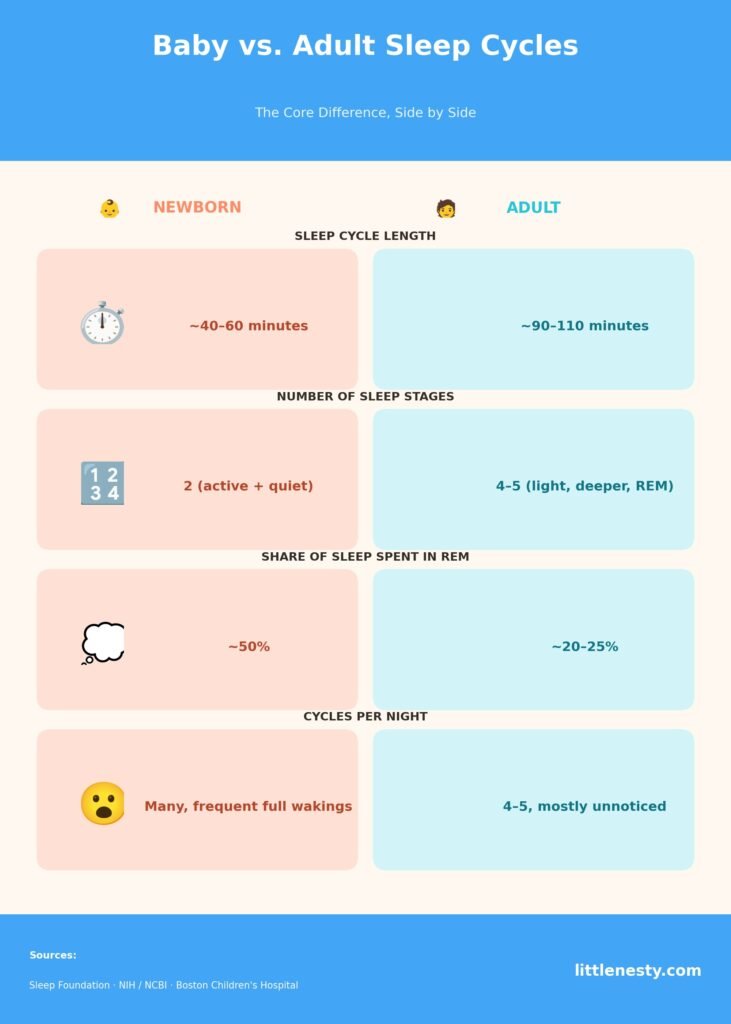
That table alone accounts for the “why won’t my baby just stay asleep” mystery new parents run into. If your newborn keeps waking every couple of hours, read our guide on why your newborn wakes up every 2 hours and what to do about it. It’s not that your baby is a uniquely bad sleeper compared to some mythical “good” baby down the street. It’s that they’re passing through the lightest, most easily disturbed part of the sleep cycle roughly twice as often as you are — and unlike you, they haven’t yet developed the neurological skill of coasting past that point without fully waking.
We remember standing over our own daughter’s crib in those early weeks, absolutely convinced the baby monitor was malfunctioning every time he twitched or grunted right on schedule, like clockwork, every forty-five minutes or so. It wasn’t a glitch. It was just a newborn sleep cycle, doing exactly what it’s supposed to do.
Active Sleep vs. Quiet Sleep: A Newborn’s Two-Stage System
Adults cycle through several distinct, layered stages of sleep each night. Newborns don’t — not yet, anyway. For roughly the first three to four months of life, a baby’s brain hasn’t matured enough to produce the more complex non-REM stages that adults experience. Instead, newborns alternate between just two states, and understanding the difference between active sleep vs quiet sleep in baby behavior is genuinely one of the more useful things a new parent can learn.
What Active Sleep Looks Like
Active sleep is the newborn equivalent of REM sleep, and it is anything but peaceful to watch. During active sleep, you’ll typically notice:
- Fluttering eyelids, often with visible eye movement underneath
- Twitching hands, feet, or facial muscles
- Grunts, sighs, whimpers, or fleeting little half-smiles
- Irregular breathing — quick, then slow, occasionally pausing for a beat before resuming
If you’ve ever hovered over a crib fully convinced your baby was about to wake up screaming, only for them to settle right back down on their own a minute later, this is almost certainly what you were watching. It looks like distress. Most of the time, it’s just a very busy brain hard at work.
What Quiet Sleep Looks Like
Quiet sleep is the newborn equivalent of deep, non-REM sleep, and it’s the stretch every tired parent is quietly hoping for. Limbs go still. Breathing slows and evens out. The face goes completely slack, jaw loose, nothing twitching. This is the deep, restorative stage where a baby is genuinely hardest to rouse — and, practically speaking, it’s usually your safest window to leave the room.
Why Babies Start With Active Sleep First (Unlike Adults)
Here’s the detail that trips up almost every new parent at some point: adults ease into sleep through progressively deeper non-REM stages, and only reach REM sleep later in the cycle, often twenty minutes or more after drifting off. Newborns do the exact opposite. They drop straight into active, REM-like sleep the moment they fall asleep, and only settle into quiet sleep afterward.
This single fact explains so many of those maddening, “but they were sound asleep in my arms” moments. If you lay a baby down during that first stretch — which, remember, is where every newborn’s sleep cycle begins — you’re setting them down during their lightest, most easily disturbed stage, almost by definition. It isn’t bad timing or bad technique on your part. It’s biology quietly working against you for the first ten to twenty minutes of every single nap.
Common Myths About Baby Sleep Cycles You Can Let Go Of
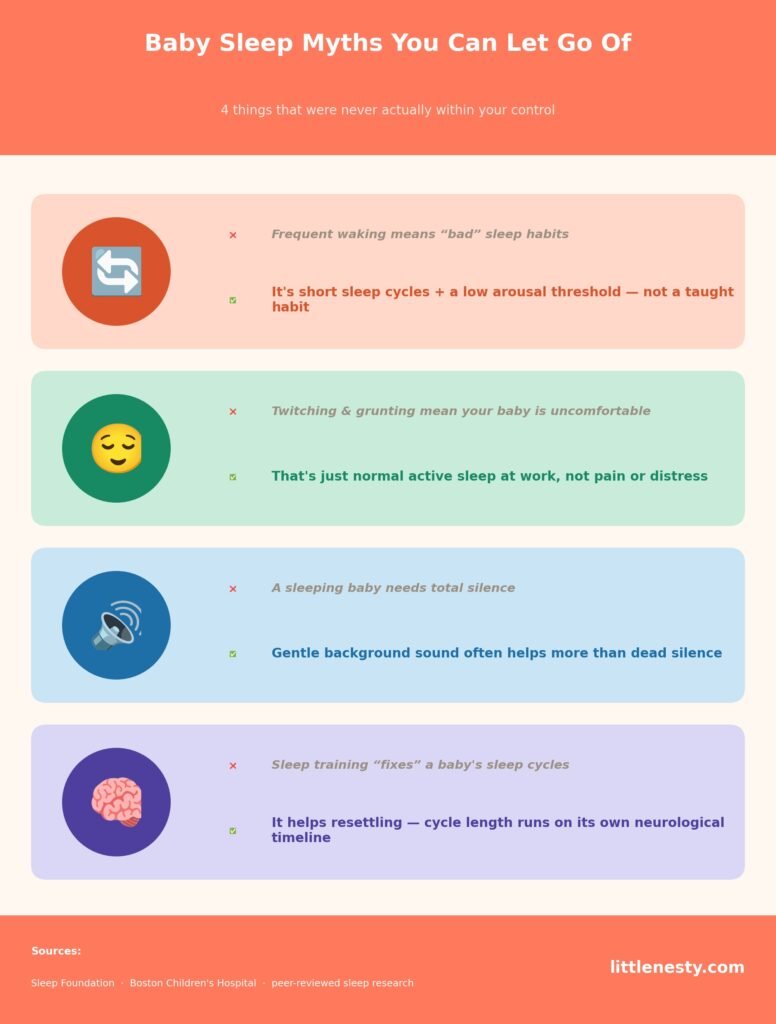
Once you start reading about baby sleep cycles, it’s easy to run into advice that sounds authoritative but doesn’t actually hold up against the science. A few of the more persistent ones worth retiring:
Myth: A baby who wakes often has “bad” sleep habits. Frequent wakings in the newborn months are a direct consequence of short baby sleep cycles and a naturally low arousal threshold, not a habit that’s been accidentally taught. There’s very little a caregiver does in the first weeks of life that meaningfully changes how often a newborn’s brain surfaces between cycles.
Myth: Twitching and grunting mean your baby is uncomfortable. As covered above, this is almost always active sleep at work — a normal, expected phase of every newborn’s sleep cycles, not a sign of pain, gas, or distress that needs fixing.
Myth: A sleeping baby needs total silence. Because babies move through such short cycles and spend so much of the night in a lightly aroused state, a totally silent room can actually make ordinary household sounds feel more jarring by contrast when they do occur. Consistent, gentle background sound often supports smoother transitions between cycles better than dead silence does.
Myth: Sleep training “fixes” a baby’s sleep cycles. Sleep training approaches, when families choose to use them, generally address a baby’s ability to resettle independently after stirring between cycles. They don’t change the underlying cycle length or the active-to-quiet ratio itself — both of which are governed by neurological maturity, which runs on its own internal timeline regardless of technique.
Clearing up myths like these doesn’t just satisfy curiosity for its own sake. It tends to quiet the guilt spiral many parents fall into at 3 a.m., wondering what they did wrong to “cause” a pattern that was never within their control to begin with.
Infant REM Sleep: The Engine Behind Early Brain Growth
It’s tempting to read all that twitching and grunting as “bad” sleep, something to be minimized, slept through, or trained away as quickly as possible. Sleep researchers see it very differently, and once you understand why, it’s hard to see it any other way yourself.
Infant REM sleep isn’t a glitch in the system. It may well be the whole point. A newborn’s brain is in the middle of an enormous construction project — forming new neural connections at a pace it will genuinely never match again at any later point in life — and REM sleep appears to play a direct, active role in that process. Researchers studying infant sleep architecture using EEG monitoring have documented the same active-and-quiet cycling pattern in babies as early as 25 weeks of gestation, well before birth even happens, which tells you just how fundamental this particular rhythm is to early neurological development.
That’s also why the proportions look so lopsided compared to grown-up sleep. A newborn spends roughly half of all sleep time in active, REM-type sleep. By their first birthday, that share has typically dropped to near 30 percent, and it declines gradually through early childhood until it settles into the adult range of around 20 to 25 percent — usually at five years of age. Your baby isn’t dreaming for hours on end because something’s off. They’re dreaming for hours on end because that is, quite literally, how a brain gets built.
Why Babies Are Light Sleepers (And Why That’s Actually a Good Thing)
If there’s one phrase that sums up early parenthood, it might be some version of “why is my baby such a light sleeper?” muttered at 3 a.m. by someone who hasn’t showered since Tuesday. The honest, science-backed answer: because being easy to wake is, biologically speaking, exactly what a newborn is supposed to be.
Remember that active sleep — the stage every baby starts in, the stage they spend nearly half their sleeping hours cycling through — comes paired with irregular breathing and a noticeably lower arousal threshold than deep quiet sleep. Researchers who study Sudden Infant Death Syndrome have found that the ability to arouse from sleep during vulnerable moments is one of the more important protective mechanisms in early infancy. In other words, that maddening tendency to stir, startle, and half-wake at every little creak isn’t a flaw that needs to be engineered out of your baby through better technique. It may genuinely be a built-in safety feature, doing exactly the job it evolved to do.
This is also part of the reasoning behind the American Academy of Pediatrics’ safe sleep recommendations — always placing a baby on their back, on a firm, bare sleep surface, without loose blankets, pillows, or soft bedding nearby. Those guidelines exist precisely because babies spend so much of the night in this lighter, more vulnerable state, and the sleep environment needs to actively support a baby’s natural ability to arouse if something goes wrong, rather than working against it. (If you want the full picture, we cover this in much more depth in our safe sleep guidelines guide.)
So the next time your baby jolts fully awake because the neighbor’s dog barked two houses down, it might help to reframe it: that’s not a broken sleeper lying in that crib. That’s a nervous system doing precisely what millions of years of evolution built it to do, whether it’s convenient for your evening or not.
Newborn Sleep Science Explained: How Cycles Change Month by Month
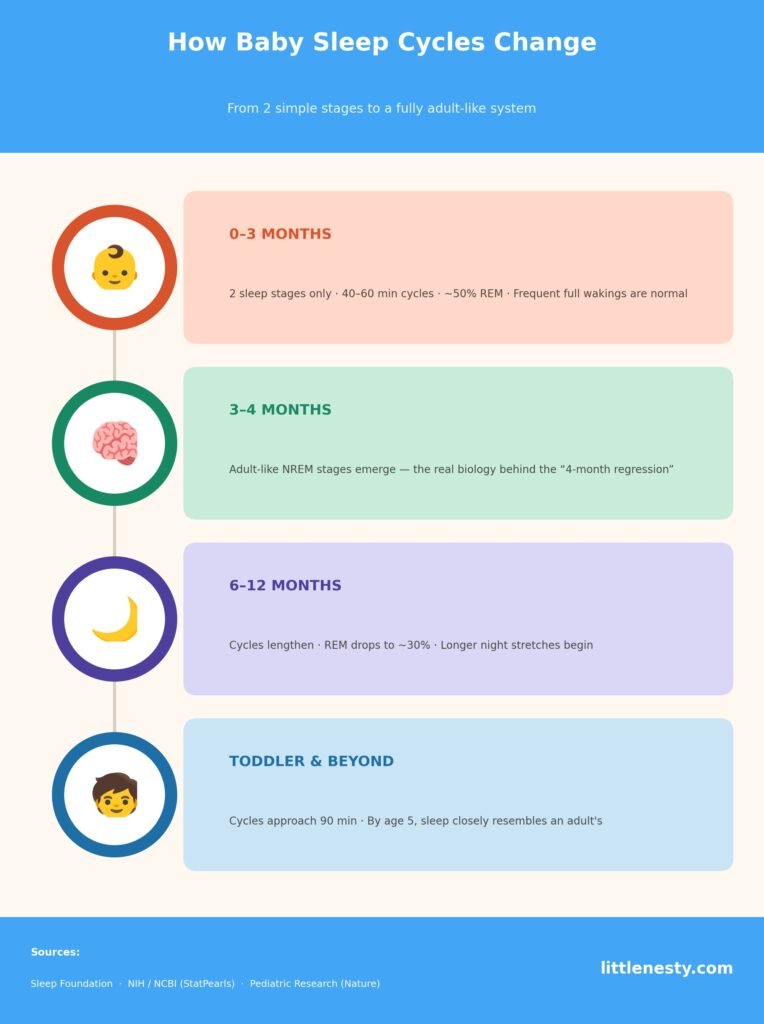
The two-stage, mostly-active-sleep system doesn’t last forever. In a lot of ways, newborn sleep science explained simply is really the story of a brain gradually catching up to adult architecture, piece by piece, over the first several years of life. Here’s roughly how that unfolds:
0–3 months: Just two sleep stages exist — active and quiet — with nothing in between. Wondering how much sleep your baby actually needs at this age? Explore our complete guide to newborn sleep duration for babies aged 0–3 months. Cycles run about 40 to 60 minutes each. Roughly half of all sleep is spent in active/REM sleep. Frequent full wakings between cycles are completely normal here; your baby genuinely hasn’t developed the neurological skill of self-soothing back down yet, so don’t mistake this stage for a problem you need to fix.
3–4 months: A real, measurable neurological shift happens around this window. Babies begin developing the same layered non-REM stages that adults have, on top of REM sleep. This maturing sleep architecture is the actual biological event behind the well-known “4-month sleep regression” — it isn’t that sleep is getting worse; it’s that sleep is getting more complex and more grown-up, and that transition can temporarily throw off patterns that felt settled just weeks earlier.
6–12 months: Cycles gradually stretch longer, and active/REM sleep drops to somewhere around 30 percent of total sleep time. Many babies begin consolidating longer nighttime stretches during this window, especially alongside consistent bedtime routines and age-appropriate wake windows.
Toddlerhood and beyond: Cycles keep lengthening toward that 90-minute adult range, and REM sleep keeps shrinking as a share of the total. By around age five, most children’s sleep architecture closely resembles an adult’s in almost every measurable way, REM percentage included.
Knowing this timeline in advance won’t make any single 2 a.m. wake-up feel shorter in the moment. But it does let you swap out “what am I doing wrong” for “what stage is this, and roughly how long does it usually last” — which, in our experience, is a much easier question to sit with in the dark.
What This Actually Means for Your Family
All of this sleep science is genuinely interesting, but you didn’t come here for a biology lecture — you came here because you’re exhausted and want something useful. Here’s how to actually put it to work.
Expect frequent wakings, especially in the early months. With 40-to-60-minute cycles and a brain that starts every single one in its lightest, most easily disturbed stage, multiple wakings a night during the newborn period aren’t a sign that anything has gone wrong. They’re the expected output of a system that’s working exactly as designed, even if it doesn’t feel that way at 3 a.m.
Give it a beat before rushing in. When your baby stirs, grunts, or briefly cries out, it’s often worth pausing for a minute or two before swooping in. A lot of what looks like “waking up” is really a baby moving through active sleep and settling back down entirely on their own — and rushing in too fast can interrupt a transition that would have resolved itself with no help at all.
Time your put-downs around quiet sleep, whenever you can. Since babies enter active sleep first, laying a baby down the instant their eyes close often means putting them down during the most easily disturbed stretch of the entire cycle. Waiting until their body has gone properly heavy and limp, and their breathing has slowed into a steady rhythm, means you’re working with the cycle instead of fighting it.
Keep the sleep environment consistent and safe, every single time, no exceptions. Because babies spend so much of the night in this lighter, more vulnerable state, a firm sleep surface, back sleeping, and a bare crib aren’t just boxes to check off a list. They’re doing real protective work during precisely the hours your baby needs it most, so consistency matters more than it might seem on any one ordinary night.
Don’t panic when the regressions hit. The 3-to-4-month shift in particular trips up a lot of families who assumed they’d finally “figured out” sleep, only to watch it seemingly fall apart overnight. Knowing in advance that this is a brain leveling up, not a step backward, makes it a lot easier to ride out.
When to Loop In Your Pediatrician
Most of what’s described here — frequent waking, twitching, grunting, occasionally noisy breathing during active sleep — is developmentally normal and nothing to lose additional sleep worrying over. That said, it’s worth bringing up with your pediatrician if you notice any of the following:
- Your baby seems unusually difficult to wake, even for scheduled feeds
- Breathing that seems genuinely labored, rather than just occasionally irregular
- Very little time spent in still, quiet sleep at all, night after night
- Excessive daytime sleepiness paired with poor weight gain
- Any sudden, dramatic shift away from your baby’s usual sleep pattern
None of this is meant to diagnose anything on its own — it’s simply a general guide for recognizing when a conversation with your child’s doctor is the right next move, rather than another round of late-night searching.
Frequently Asked Questions
How long is a normal baby sleep cycle? For newborns, a typical sleep cycle lasts about 40 to 60 minutes — roughly half the length of an adult’s 90-110-minute cycle. This gradually lengthens across the first year and keeps stretching through early childhood.
Is it normal for my baby to twitch, grunt, or cry out while sleeping? Yes, almost always. This is characteristic of active sleep, the newborn version of REM sleep, and it’s considered a normal — even necessary — part of early brain development, not a sign of pain or impending wakefulness.
Why does my baby wake up the second I put them down? Because babies enter active sleep, their lightest and most easily disturbed stage, first — rather than last, as adults do. Waiting for heavy limbs and slow, even breathing before transferring them gives you a much better shot at a smooth handoff.
When will my baby’s sleep start looking more like mine? The biggest shift happens around three to four months, when babies begin developing adult-style non-REM sleep stages for the first time. Full adult-like sleep architecture, cycle length, and REM percentage included, generally isn’t reached until somewhere around age five.
Does active or REM sleep have anything to do with SIDS risk? Research suggests a baby’s ability to arouse from sleep is an important protective mechanism, and that infants spend a large share of early sleep in this more easily aroused active state. This is a major part of why safe sleep practices — back sleeping, a firm surface, a bare crib — matter consistently, every single sleep, with no exceptions made for “just this once.”
Can I do anything to help my baby’s sleep cycles mature faster? Not really, and that’s actually good news — it means you’re not doing anything wrong. This maturation is driven by neurological development on its own internal timeline, not by any particular technique or product. What you can do is support the process with consistent, age-appropriate routines and a safe sleep environment, and let your baby’s brain handle the rest.
Is there a difference in sleep cycles between breastfed and formula-fed babies? The underlying sleep architecture — cycle length, the active/quiet split, the pace of maturation — is driven by neurological development rather than feeding method. Feeding schedule can influence when wakings happen, since hunger will rouse a baby regardless of sleep stage, but it doesn’t change the basic structure of the cycle itself.
Do all babies have identical sleep cycles? Not exactly — cycle length and timing vary somewhat from baby to baby, and premature infants in particular often show even shorter, more variable cycles than full-term newborns do. That said, the general pattern behind baby sleep cycles — short duration, active sleep first, a high REM share — holds true across nearly every infant, even when the exact minutes differ.
Will a “cry it out” approach change my baby’s sleep cycles? Not directly. Whatever soothing approach a family chooses for helping a baby resettle between wakings, the underlying baby sleep cycles themselves — their length, structure, and REM proportion — are set by neurological development, not by any particular method of comforting.
The Bottom Line
Baby sleep cycles were never going to behave like adult sleep cycles, and honestly, that’s entirely by design. Shorter cycles, far more time spent in active sleep, and a lower arousal threshold aren’t bugs in the system. They’re a newborn brain doing exactly what it needs to do to grow, paired with a built-in safety mechanism doing exactly what it needs to do to protect. Understanding all of that won’t add a single extra hour to your night. But it might make the next 2 a.m. wake-up feel a little less like something has gone wrong, and a little more like watching your baby’s brain do precisely what it was always supposed to do.
